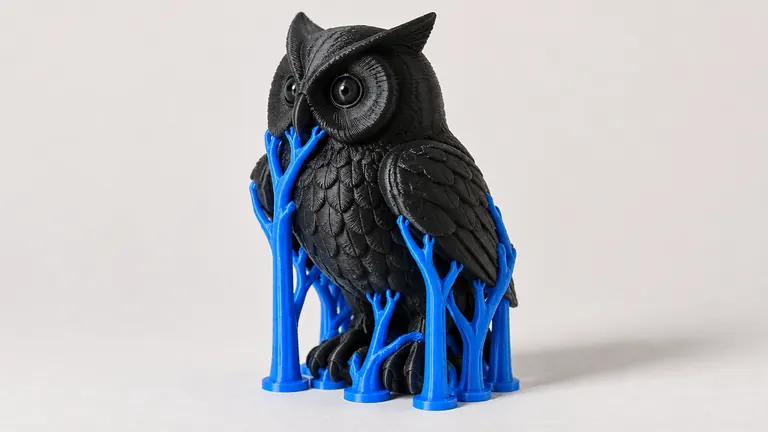
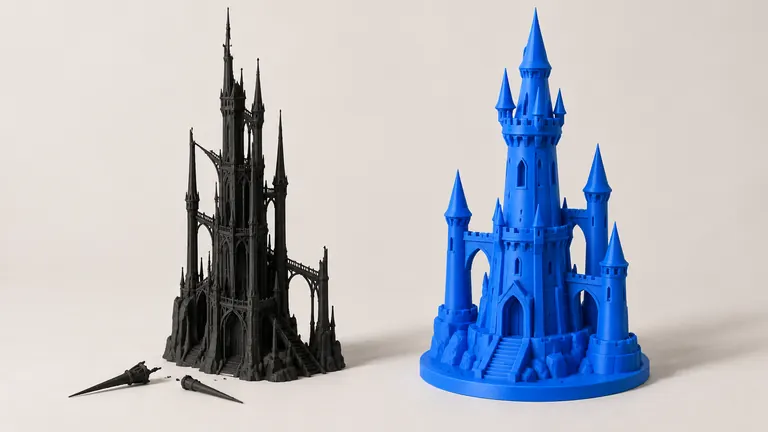
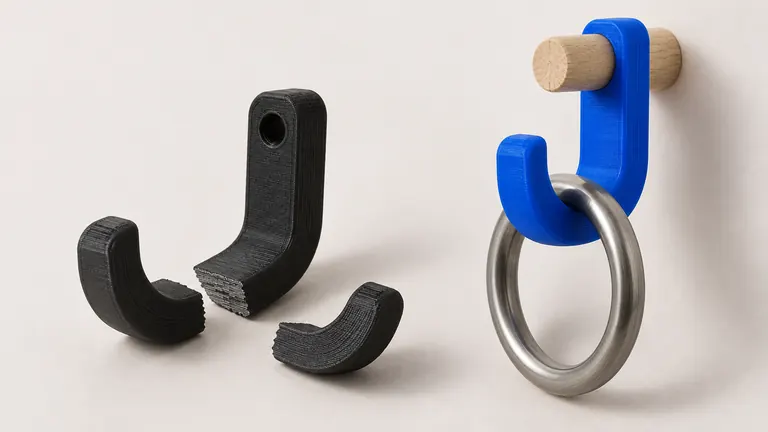
The average household loses a small plastic part every few weeks: a clip cracks, a knob strips, a foot walks away. The replacement is $12 plus shipping for a part containing nine cents of plastic — when it's sold separately at all. A 3D printer flips that math: pennies of filament, printed tonight.
This is the practical catalog — 30 parts organized by room, each with the filament that actually survives the job, plus the two honest sections most listicles skip: what you shouldn't print, and what to do when the part is broken or discontinued and there's no file to download.
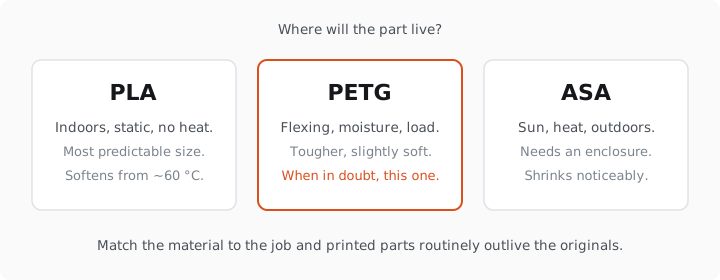
Every entry below names a filament. If you only remember one thing from this article, remember this chart — it decides nine repairs out of ten.
Kitchen
| # | Part | Filament | Why |
|---|---|---|---|
| 1 | Cabinet door bumpers and dampers | TPU or PLA | TPU deadens the slam; PLA is fine if that is all you have |
| 2 | Drawer slide clips | PETG | The part that breaks in every IKEA kitchen — it flexes on every open |
| 3 | Appliance knobs (stove excluded — see safety) | PETG | Measure the D-shaft with calipers before you print |
| 4 | Fridge shelf supports | PETG, 6 perimeters | These carry real load, and they carry it cold |
| 5 | Jar lid organizers, bag clips | PLA | The classic. Occasional dry food contact only |
| 6 | Dishwasher basket corner caps | PETG | Survives heat-dry cycles where PLA deforms |
Bathroom
| # | Part | Filament | Why |
|---|---|---|---|
| 7 | Toilet seat hinge caps and bumpers | PETG | Moisture rules out PLA here |
| 8 | Towel hook | PETG | Print it on its side so layers run across the load — orientation is the difference between a hook and confetti (why →) |
| 9 | Shower curtain rings and glides | PETG | Constant small flexing |
| 10 | Soap dish / razor holder | PETG | Model drain slots or it becomes a soup bowl |
| 11 | Cabinet catch plates | PLA | Dry and static, indoors — PLA is enough |
Furniture
| # | Part | Filament | Why |
|---|---|---|---|
| 12 | Chair and table foot caps | TPU ideal, PETG workable | Measure the inner diameter, not the outer |
| 13 | Shelf pins | PETG | Print a test batch of four before committing to twenty |
| 14 | Bed frame corner brackets | PETG, 6 walls / 40 % infill | Static load only — see the safety section for what that excludes |
| 15 | Recliner and sofa handle levers | PETG | A famously discontinued part; usually cheaper to print than to source |
| 16 | Curtain rod brackets and glider hooks | PETG | Light but constant load |
| 17 | Drawer pulls and knobs | Anything | The fun one — this is where people start customising |
Appliances and electronics
| # | Part | Filament | Why |
|---|---|---|---|
| 18 | Vacuum attachment adapters | PETG | The 32-to-35 mm adapter is the most-printed object in this category for a reason |
| 19 | Remote control battery covers | PLA | The eternal loss. Ten minutes and it is back |
| 20 | Washing machine dial skirts and button caps | PETG | Warm, damp, handled daily |
| 21 | Cable clips, raceways, desk grommets | PLA | Indoors, static, invisible — PLA all the way |
| 22 | Router and console wall mounts | PETG | Keep the ventilation cutouts; heat kills electronics faster than gravity |
| 23 | Robot-vacuum brush guards and wheel caps | PETG | Abrasion and impact |
Outdoor and garage
| # | Part | Filament | Why |
|---|---|---|---|
| 24 | Hose nozzle holders and hangers | PETG minimum, ASA in sun | PLA sags by July |
| 25 | Broom and tool wall clips | PETG, 5+ perimeters | They get yanked, not lifted |
| 26 | Gate latch components (non-security) | ASA | UV plus weather |
| 27 | Bike light brackets, fender clips (not seat or handlebar parts) | PETG or ASA | Nothing that holds your weight |
| 28 | Trash bin lid hinges | PETG | The part that always snaps, on every bin ever made |
Kids and misc
| # | Part | Filament | Why |
|---|---|---|---|
| 29 | Toy battery covers and snapped brackets | PLA | The highest gratitude-per-gram category in this list |
| 30 | Board game inserts and replacement tokens | PLA | Technically not a repair. Spiritually essential |
What NOT to print — the section that keeps you safe
Skip anything where failure hurts someone: load-bearing safety parts (ladder feet, climbing hardware, car suspension anything), high-heat parts (stove knobs, anything touching heating elements — standard filaments soften from ~60 °C for PLA), food-contact items for repeated use (layer grooves harbor bacteria; occasional dry contact like a bag clip is fine, a daily-use cutting board isn't), and pressurized parts (compressor fittings, pressure-cooker anything). Electrical enclosures: fine for low-voltage cable tidying; leave mains-voltage boxes to certified parts.
When there's no file to download: the broken-part workflow
For maybe a third of this list, someone already modeled your exact part — search Printables, MakerWorld and Thingiverse first. The other two thirds is where it gets interesting: the part is proprietary, discontinued, or subtly different from every downloadable version.
You have three options, in ascending order of effort: photograph it and let AI reconstruct it — works from the intact twin of a broken part, or even the product photo from the listing you'd rather not pay for; the full technique, including the scale-calibration step that makes the part actually fit, is in our photo-to-print workflow guide →. Remodel it in CAD — the right call for threads and precision fits. Hybrid — generate the organic body from a photo, add the precision feature in CAD.
If you take the photo route, one warning from experience: a raw AI-generated mesh usually isn't printable as-is — here's what breaks and why →. PHORM automates that whole cleanup: photo in, repaired and verified model out, with a profile for your Bambu printer, and if it fails our printability check it doesn't count. Try 5 models free → — the trash bin hinge is a fifteen-minute test.